
The standard trajectory for an unwanted piece of furniture in a Czech flat is the municipal bulky waste collection. The alternative — functional upcycling — does not require significant skill or investment, and the range of transformations possible with a tin of paint, a new set of handles, or a different configuration is wider than most people assume.
This guide addresses the most common scenarios: painting laminate and veneer furniture, hardware replacement, decoupage on flat surfaces, and structural repurposing of pieces that are too worn for their original function.
Painting Laminate Furniture
Laminate — the paper-foil or thin melamine surface found on most Czech flat-pack and older factory furniture — does not bond readily to standard paint. Two preparation steps make the difference between a finish that lasts and one that peels within weeks.
Surface Preparation
Clean the surface with a degreasing agent (isopropyl alcohol works well and is available at any pharmacy). Abrade lightly with 240-grit sandpaper — enough to dull the gloss and create mechanical bite, not enough to sand through the laminate. Wipe clean with a tack cloth.
Primer Selection
Use a shellac-based primer (BIN by Zinsser is available in Czech hardware stores) or a dedicated adhesion primer formulated for non-porous surfaces. Standard acrylic primers do not adhere reliably to laminate without this step. Apply two thin coats and allow full drying between them.
Topcoat
Furniture-grade water-based acrylic paints in a satin sheen give the most durable result for painted laminate. Apply two to three coats with a foam roller (for large flat panels) or a fine synthetic brush (for doors and edges). Sand lightly between coats with 320-grit.
Full cure takes five to seven days. Avoid placing heavy objects on painted shelves for at least three days after the final coat.
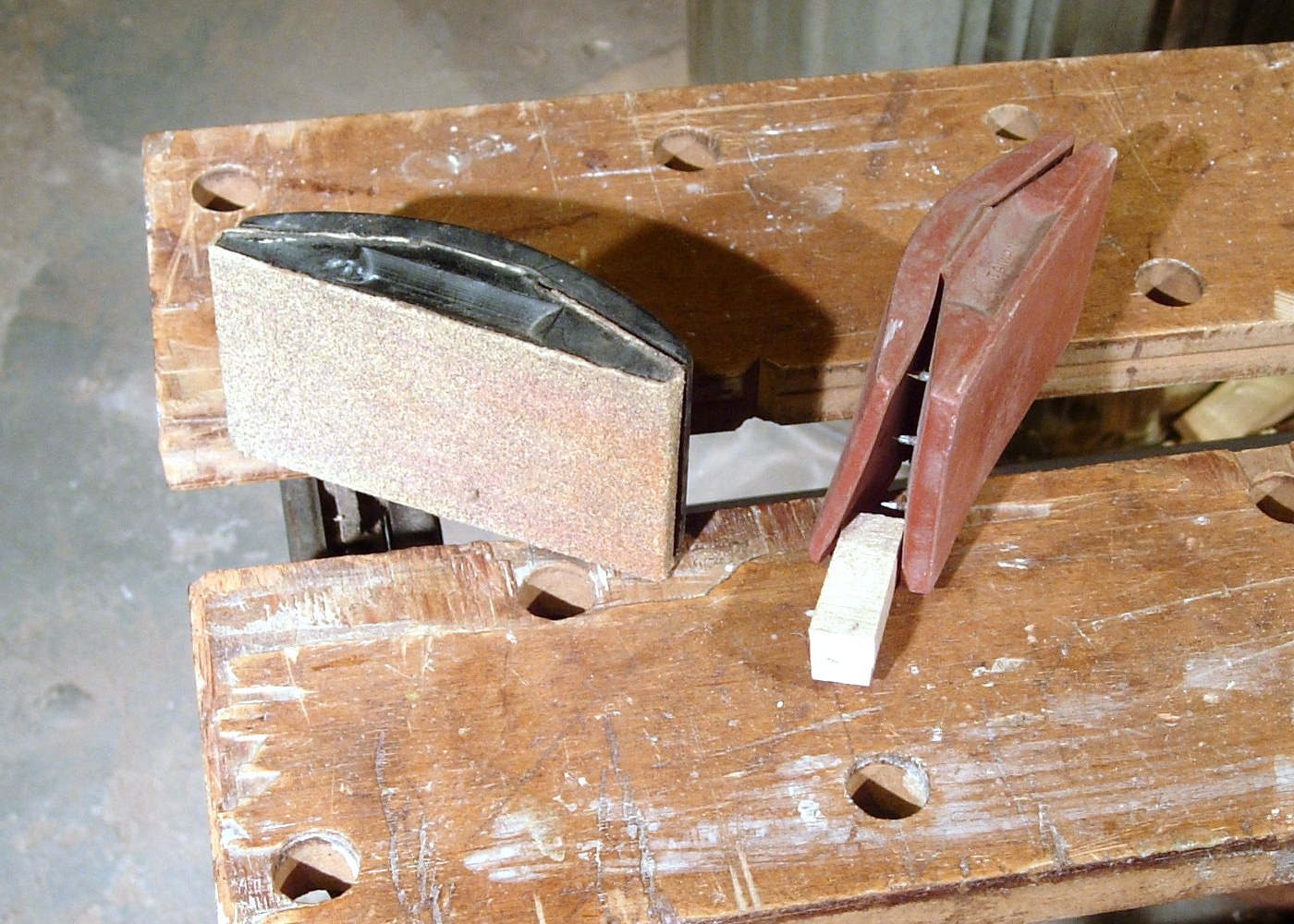
Sanding blocks allow controlled abrasion on flat panels — critical for creating adhesion on laminate without sanding through the surface. Source: Wikimedia Commons, CC BY-SA 4.0
Hardware Replacement
Changing the handles, knobs, and hinges on a piece of furniture is the fastest upcycling intervention available. A set of dated brass drop handles replaced with black matte bar pulls changes the decade of the piece immediately — without any paintwork.
Measuring for New Hardware
The critical measurement is the bore-to-bore distance — the spacing between the two screw holes on a bar pull or bail handle. Standard Czech factory furniture uses 64 mm, 96 mm, and 128 mm spacing. Measure before ordering, as mismatched holes require filling and redrilling.
For knobs replacing pulls, or vice versa, the existing holes need to be filled (with wood filler or a wooden plug and filler) before new positions are marked.
Where to Source Hardware in the Czech Republic
IKEA carries a basic range. Specialist furniture hardware suppliers in Prague (Nábytkové kování shops in Holešovice and Žižkov) stock a far wider range of finishes, profiles, and fixing types. Aliexpress ships to Czech addresses for unusual or decorative handles not available locally.
Decoupage on Flat Surfaces
Decoupage — adhering paper cutouts under multiple coats of varnish — is suited to drawer fronts, tabletops, and cabinet panels with minimal surface complexity. It covers small defects, adds pattern, and produces a result that is genuinely hard-wearing when properly sealed.
Materials
- Decorative paper (gift wrap, maps, botanical prints, patterned tissue)
- PVA glue thinned 50/50 with water, or dedicated decoupage medium
- Foam brush
- Brayer roller for removing air bubbles
- Oil-based polyurethane for the final seal (at least four coats for a tabletop)
Technique
Prepare the surface as for painting — clean, sand, and prime. Tear rather than cut paper edges for irregular joins that blend rather than show. Apply diluted PVA to the surface, lay paper, brush more PVA over the top, and work out bubbles with the brayer. Allow each layer to dry before adding the next.
For a tabletop, seal with at least four coats of oil-based polyurethane. Water-based varnishes can re-wet PVA adhesive and cause lifting.
Structural Repurposing
Some pieces are structurally sound but functionally obsolete — a large wardrobe from a 1970s apartment that no longer fits the space, or a dining table that is too large for the room. Repurposing changes the function rather than the surface.
Wardrobe to Bookcase
Remove the hanging rail and add intermediate shelves. Add adjustable shelf pin holes with a drill and a 5 mm bit — mark a grid of holes 32 mm apart on the inner panels and insert shelf pins (available from any hardware store). Paint or refinish the exterior if the original finish is dated.
Coffee Table to Storage Bench
A solid coffee table with a frame height of 42–48 cm can function as a storage bench at the foot of a bed. Build or buy a foam seat pad to the same dimensions as the tabletop, upholster it, and attach with screws from underneath. The result is a piece that reads as intentional rather than improvised.
Single Wardrobe to Hallway Cabinet
A single-door wardrobe — often discarded because it is too shallow for modern clothing — has the right dimensions for a hallway cabinet. Add hooks to the inside door for keys and bags, fit a small shelf for post and keys at the bottom of the hanging space, and add a mirror to the door exterior.
Colour Considerations
Czech apartment walls tend toward white or off-white with limited natural light in many rooms. Strong painted furniture colours — deep olive, charcoal, navy — read well in these conditions and have the advantage of making older furniture look deliberately chosen rather than inherited by default.
Chalk paint (Autentico and Annie Sloan are both available in the Czech Republic) does not require priming on most surfaces and gives a matte, period-appropriate finish that suits older piece shapes.

