
An upholstered dining chair with a sagging seat or torn covering is one of the most accessible furniture projects. The structure — typically a wooden frame with a drop-in seat pad — requires no specialist tools, and a careful first attempt produces a result that is almost indistinguishable from professional work.
This guide focuses on drop-in seat pads and simple armchair cushions, which are the most common upholstery repairs encountered in Czech apartment furniture from the 1960s through to the 1990s.
Understanding the Construction
Most drop-in chair seats have a plywood or softwood frame, a base layer of jute or elastic webbing, a foam or horsehair pad, and one or two layers of calico or wadding beneath the face fabric. Understanding this stack tells you what needs replacing and what can be reused.
Press down on the seat. If it springs back, the webbing is intact. If it sags or feels uneven, the webbing needs replacement. If the foam feels flat or crumbles, it must be replaced regardless of the fabric condition.
Materials Required
- Upholstery fabric — minimum 300 g/m² for a seat that will see daily use
- Polyurethane foam, density 40–50 kg/m³, cut to thickness (typically 50 mm for a dining seat)
- Polyester wadding, 100 g/m²
- Jute webbing or elastic webbing straps
- Webbing stretcher (or improvise with a folded rag over a dowel)
- Upholstery staple gun with 8 or 10 mm staples
- Tack hammer and 10 mm upholstery tacks (if the frame is too thin for staples)
- Ripping chisel or flat-head screwdriver for removing old tacks
- Scissors or rotary cutter and cutting mat
- Marker pen for cutting guides
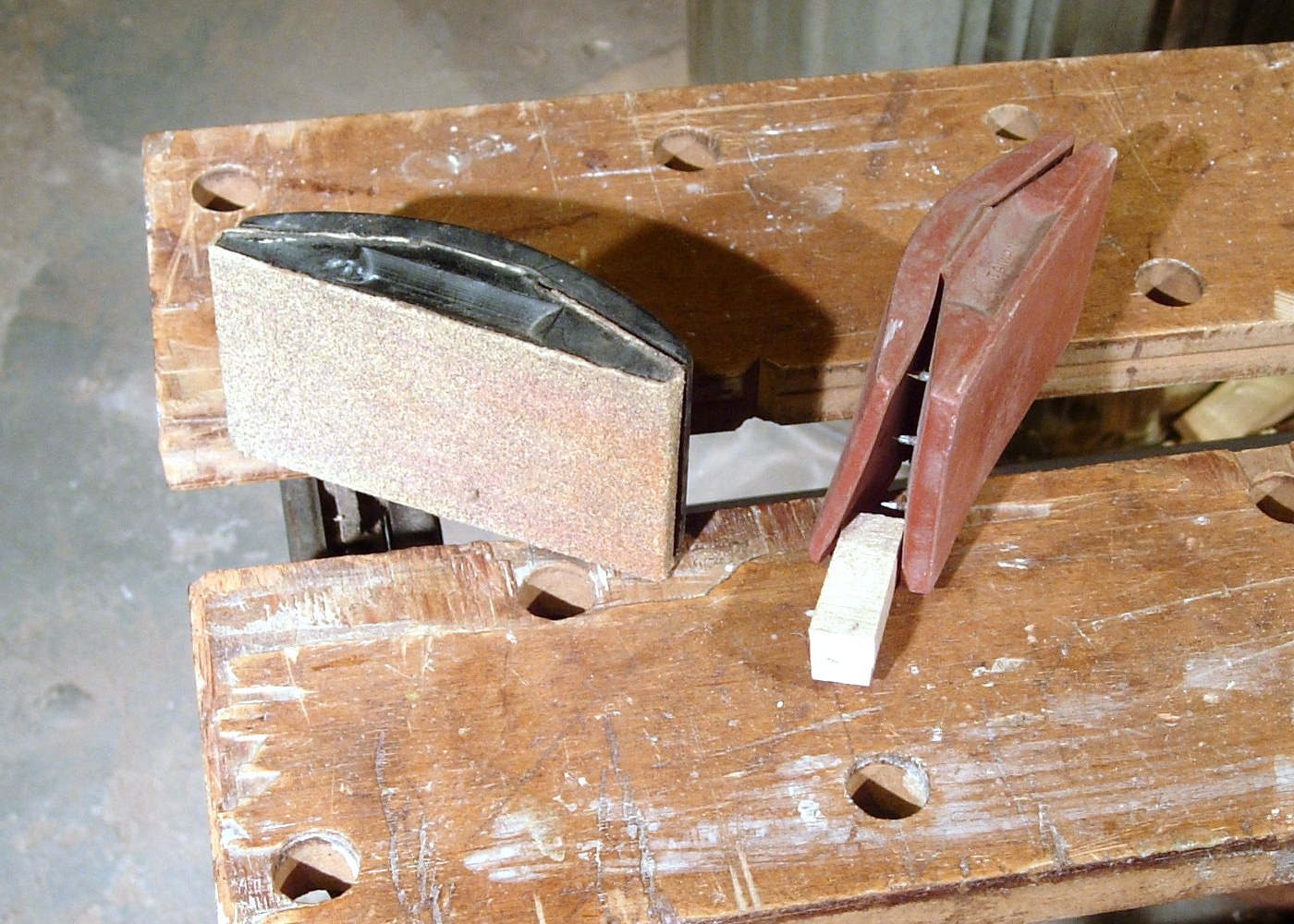
Sanding the wooden chair frame before covering avoids rough edges that can tear new fabric from the inside. Source: Wikimedia Commons, CC BY-SA 4.0
Step 1 — Strip the Old Upholstery
Remove the seat pad from the frame — most drop-in seats are held by four screws from beneath, or simply sit in a rebate. Work methodically: remove face fabric first, then any wadding or calico, then the foam, then the webbing. Photograph each layer as you go — this documents the construction and gives you a cutting template.
Remove old staples with a ripping chisel and mallet, or a flathead screwdriver and pliers. Do not leave old staples in place — they create lumps under new fabric and eventually work through it.
Step 2 — Inspect and Repair the Frame
Check for loose joints, splits, and woodworm holes. Tap joints with a mallet — a hollow sound indicates a loose or failed glue joint. Re-glue and clamp before continuing. Fill any woodworm exit holes with wood filler and treat with a borax-based woodworm fluid.
Sand any rough edges on the frame — sharp corners will eventually cut through fabric from the inside.
Step 3 — Replace the Webbing
If webbing is needed, weave jute straps across the frame, interlacing them for stability. Use a webbing stretcher (or the improvised version) to pull each strap tight before tacking or stapling. The webbing should feel drum-tight — it will soften slightly under load, and insufficient tension leads to a saggy seat within months.
Elastic webbing is easier to install and performs well for seats with moderate use. It is particularly suited to occasional chairs and bedroom pieces.
Step 4 — Cut and Fit the Foam
Cut foam with a long-bladed serrated knife or an electric carving knife — a sharp bread knife works well. Trace the seat base on the foam, then add 10 mm to each side so the foam wraps slightly over the frame edge. This creates a rounded profile rather than a flat, boxy seat edge.
Glue the foam to the frame base using spray contact adhesive. Allow both surfaces to become tacky before pressing together. Work on a flat surface to avoid warping the seat.
Step 5 — Wrap with Wadding
Cut a piece of polyester wadding to the same size as the foam (with the same 10 mm overhang). Drape it over the foam and staple or tack the underside. Wadding softens the transition from foam edge to frame and fills any surface irregularities in the foam.
Step 6 — Cut the Face Fabric
Lay the old fabric flat and use it as a template — add 50 mm to each edge for folding under the frame. If no template is available, measure the seat, add twice the foam thickness plus 60 mm to each dimension.
Check fabric direction. Patterns and weave direction should run front-to-back on a seat — this looks most natural when viewed from the front. Cut with a sharp rotary cutter against a steel ruler for straight edges.
Step 7 — Staple the Fabric
Place the fabric face-down on a clean surface, centre the seat pad on top (foam-side down), then fold and staple. Work in this order: centre front, centre back, centre left, centre right. Then work from those points outward toward the corners, pulling the fabric taut but not so tight it distorts the surface pattern.
At corners, fold a neat pleat — or for rounded corners, cut small relief notches and fold the fabric in overlapping layers. Keep the staple spacing even at approximately 20–25 mm.
Common Problems
Puckered fabric at corners
Usually caused by too much fabric bulk. Trim excess fabric before folding, and fold a single clean pleat rather than gathering multiple layers. A tack hammer can flatten stubborn bulk before stapling.
Visible staples at seat edge
The fabric was pulled too far under the frame. The fold line should sit at or just inside the frame edge. Remove the staples in that section and reposition.
Foam creasing under fabric
The foam density is too low or the wadding layer was skipped. Low-density foam (below 30 kg/m³) compresses unevenly under use and creates surface creasing that shows through fabric.
Sourcing Fabric in the Czech Republic
Upholstery fabric is available at specialist textile shops in Prague (Holešovice fabric market), Brno, and Ostrava. Online suppliers including Textilbazar and Tkany carry a wide range of technical upholstery grades. For foam, Hornbach and specialist foam-cutting shops (pěnový řezač) carry standard grades and can cut to size.
